

This is the first of a seven-part series about a trek across the Baja—timely I hope, since it includes a bit of holiday cheer. Please ride along, armchair or otherwise. I hope you enjoy it. I’ll post Part 2 tomorrow. —Ken
From Sea to Shining Sea
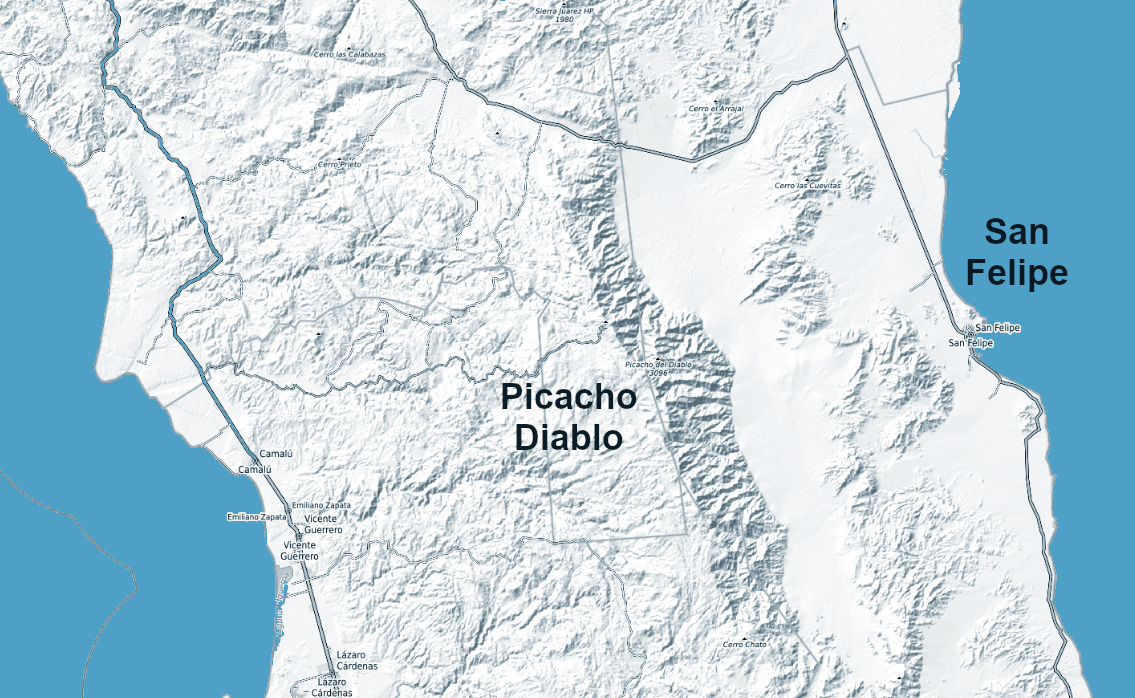
In late 1982, a hiking buddy and I, temporarily unemployed and eager to travel, seized on the big idea of a week-long trek across the 80-mile wide Baja peninsula in Mexico. Dennis and I would hike from the Sea of Cortez on the east shore, then march west to the Pacific Ocean. The walk would include a 30-mile crossing of the Sonoran Desert and a multi-day traverse of the mountains of the Sierra San Pedro Mártir. Our plan called for summiting, en route, the highest hunk of rock in the Baja, 10,157-foot Picacho del Diablo, the Devil’s Mountain. And we would do it in December.
So, an enchanted holiday with the Devil. What could be more fun than that?
We obviously anticipated a fine adventure. What I did not expect was one of the most memorable Christmas Eves I’ve ever experienced.
We would begin our trek on a beach in the quiet, somewhat isolated fishing town of San Felipe, cozy on a bay of the same name on the Sea of Cortez. The town lies about 120 miles south of the U.S.-Mexico border. After ceremoniously dipping our toes there, we hoped to end within a week with a splash on some magical Pacific shore well to the south of Ensenada.
We estimated our actual hiking distance to be a bit over 100 miles. Despite heavy packs, uncertain desert roads and no trail through these rugged mountains, we guessed we could average 15 to 20 miles per day for six days. We prepared for seven. We could go hungry for a couple days if the trek lagged much longer than that.
I don’t know where I got my climate data from, but I had it in my head that the beach and the desert would be warm, but not too hot since we’d be there late fall, which was more or less correct. And the mountains? Mild, we figured, with maybe some cold nights and a little snow at elevation. It had not occurred to me that we might run into a glaze of ice above 6,000 feet. Nor did I foresee hours of upward wallowing in thigh-deep powder snow.
Also not part of the plan were delays due to bad directions, a bad ankle sprain and a herd of thieving cats. Had we considered the comical abundance of twists and turns we’d experience along our journey? Uh, no. Or the potential danger we could face had some little thing gone awry? Vaguely. Did we run out of food? Well, yes and no.
Nevertheless, we were mountaineers. We were tough. We could do this.
Spoiler alert: We survived.
Dennis and I were packed and ready to fly in early December. We landed at LAX and bussed to San Diego to spend the night before crossing into Mexico. With large mountaineering backpacks slung over our shoulders, we waddled around the city looking for a place to camp. Dennis carried a good-sized pack, full yet reasonable given our intentions. My pack, on the other hand, was hopelessly overstuffed. If I admitted that I’d tossed in a mask and snorkel for some beach time later, you’d get the general idea.
Somehow, our duck-walking around San Diego led us to the zoo late in the day. We probably fit right in, perhaps mistaken for a couple of wild emus on the loose. We poked around for an inconspicuous hidey-hole where we might camp for the night, preferably out of the reach of lions, tigers and bears. We spotted a semi-secluded grassy place just outside the zoo's walls and fences, conveniently lacking a fee station or a ranger to check in with. It was just dark enough to slink in unnoticed, scarf some dinner, and crash.
We were in for a lively evening. Honking elephants and scolding primates seemed to be lobbing vulgarities at one another over the fences. This against a backdrop of squeals, squeeks and grunts from near and far. The ruckus eventually quieted to allow us some sleep. Early the next morning, however, the zoological chatter resumed, as we slithered from our bags and repacked to avoid detection.
We scrambled up breakfast and soon reemerged nonchalant onto the street. Waddling around again to find the zoo entrance, we checked our giant backpacks at the gate and took a look around inside. After a couple of hours winking at our new zoo friends, it was time to make our way to Mexico.
By early afternoon, Dennis and I stepped off the border trolley and passed through Customs and Immigration into Tijuana. In 1982, a stroll across the border into Mexico was a non-event, at least in any bureaucratic sense. An agent scribbled something on a slip of paper, stamped the date with a smile, and we were on our way. Bienvenidos!
Stepping into Mexico, our sense of place was immediately transformed, as if we’d squeezed through a kind of time-space warp that sucked away all that was familiar. Borders should not be so stark, I thought.
Our first impression of Tijuana was, admittedly, a stereotypical one: clean and littered, new and old, paved and dirt streets, kids in empty spaces, cars from every decade, all seemingly under a veil of economic uncertainty. Perhaps to instill some confidence in a brighter future, Tijuana developers had just completed construction of the city’s Los Torres, the twin towers of the Grand Hotel. At 28 stories, they were the tallest buildings in the Baja.
A populace of a half-million scratched out a living here, while their neighbors to the north, meaning us, were about to emerge from an economic recession. In fact, due to the recession, I’d been laid off that fall from my permitting job with the county. Supposedly temporary, it squelched my income, meager as it was, but freed me up for adventure. Dennis put his landscaping business on hold. Together we had enough coins in our purses to enjoy a low-cost holiday to Mexico. In December 1982, such a thing was still possible.
My dad had lived on a boat in San Diego back in the Sixties and insisted that the border towns were not the real Mexico. For that, he and my stepmom would sail their hand-built schooner down the Baja and along the mainland as far south as Acapulco and beyond. That was the real Mexico, he said. After a brief look around at 1982 Tijuana, Dennis and I were primed for a southbound bus ride into “real” Mexico.
“Where the hell’s the bus station?” Dennis asked.
It seemed so easy looking at a map back in Bellingham. 1. Go to Tijuana. 2. Catch bus. 3. Get off at San Felipe. 4. Walk across desert. 5. Climb mountain. 6. March to Pacific.
We saw no busses, only a grazing herd of taxis. We noticed a driver standing outside his car, and walked over to him.
“How much to the bus station?” I asked, in my recently reconstituted high-school Spanish.
“Vamos a San Felipe,” Dennis added for clarity.
“Si, no problema. Vamos," the man answered, waving us into his car. “Muy rapido!”
We shoved our beastly burdens into the trunk and climbed in. When the driver said “Muy rapido,” he wasn’t kidding. We lurched forward and zoomed around a corner with the radio blaring. Our driver spoke loudly. He was curious about we two gringos with the big packs. He tried to engage us in conversation, but neither of us understood much of what he said. We grunted courteously.
After a minute or two doing the Tijuana Gran Prix, our driver suddenly nose-dived the car through a break in a fence, and we plunged down the steep side of a concrete-lined canal. A streamlet of water—the Tijuana River—flowed at the bottom. I'm thinking, Whoa, this guy can drive! Dennis sensed we were about to be mugged.
“Alto! Alto!” he yelled, insisting that the driver halt the car and let us out.
To me, the man seemed good-natured, so I assumed, or at least hoped, that he was taking us on a shortcut to the bus station. I’ve been known to have an excessively optimistic outlook in the face of, well, cars diving into canals. We dodged pools, dogs, kids and debris, before the man swung the car around and gunned it up another sidewall. We popped out of the canal and onto the street, screeching to a stop at the bus terminal.
Up next: Part 2—To San Felipe