

I was recently researching the unsuccessful effort by the Mount Baker Club of Bellingham to create a new Mount Baker National Park more than a century ago, something that would require an act of Congress to achieve. This was long before North Cascades National Park was established in 1968.
The story is juxtaposed with my first climb of Mount Shuksan in the early 1980s. The following excerpt is from my latest book called Boots on Fire, expected to be out to the world sometime in April. I’ll post more about the book soon, although you can also find a short blurb at tireddogspress.com. Enjoy!
Alan and I found that we were both quite interested in testing our mettle on Mount Shuksan, one of the most elegant great peaks of the North Cascades. If not for Mount Baker, Shuksan would probably be the grand monarch of the northern region. For both of us it would be our first attempt on the 9,125-foot-high mountain.
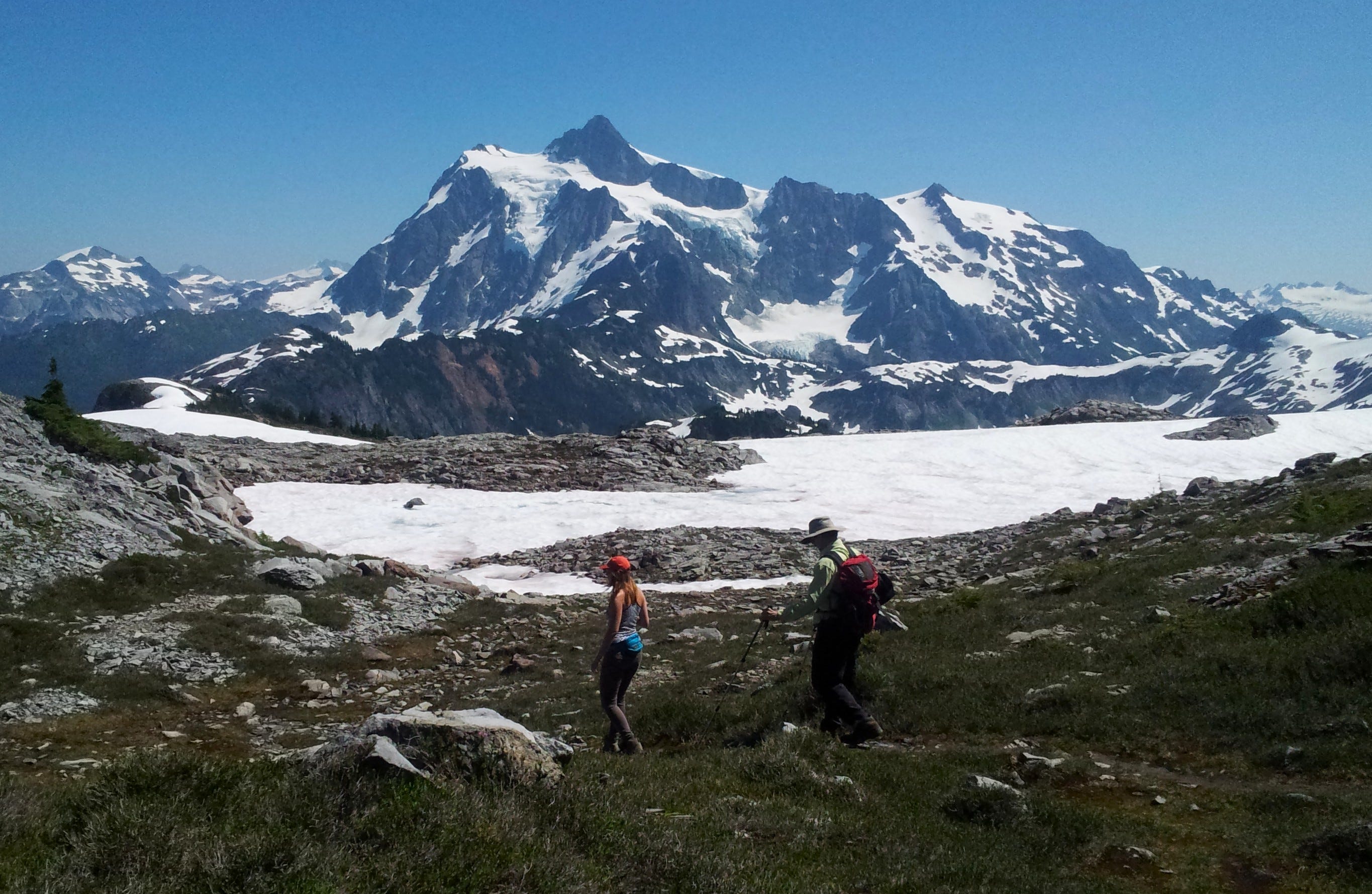
Shuksan truly epitomizes the beauty of the North Cascades and is reputedly one of the most photographed mountains in the world. The name is thought to have been derived from a Nooksack Indian term for “roaring mountain.” If I had to guess, I’d say it might have something to do with the occasional avalanches coming off the glaciers. “Roaring mountain” could almost serve as a metaphor for the long battle to protect both mountains, Shuksan and Baker, within a national park.
The first confirmed climb of the peak was in 1906 from the south by way of the Sulphide Glacier. From the late 1800s, the spectacular beauty of the alpine country from Mount Shuksan to Mount Baker had excited tourism promoters around the region. In 1911, the nascent Mount Baker Club of Bellingham initiated a legendary runners’ marathon from downtown to the summit of Baker and back. Lanky competitors in shorts, skivvies and t-shirts literally ran up miles of wilderness trails, steep snow and dangerous crevassed glaciers to the highest point, known as Grant Peak, before running back down. Judges were stationed at the summit and elsewhere to keep the contestants honest.
The Mount Baker Marathon is very nicely reenacted in the award-winning 2012 documentary Mountain Runners. Following a third run in 1913, the race was discontinued after one runner fell into a deep crevasse and nearly died. Almost every year since 1973, Bellingham’s Ski-to-Sea race has emulated the excitement of a human-powered, mountains-to-the-sea competition beginning at the foot of Mount Shuksan, but without the risk of falling into an icy chasm. The event also provides thousands of Bellinghamsters and visitors with a hell of an excuse for a town-sized party.
In 1916, Portland’s mountaineering club, the Mazamas, along with the Mount Baker Club, began to lobby Congress for the creation of a new Mount Baker National Park. Both groups had organized many climbs of Mount Shuksan and Mount Baker, as well as other peaks in the region. The meadowland between the Easton and Deming Glaciers is known as Mazama Park, the club from Portland being among its earliest explorers.
The park idea was a grand vision nearly realized. The proposal included Mount Baker and Mount Shuksan as well as a vast area of wilderness south of the Canadian border and all the way east to the Picket Range. The Mount Baker Club’s Charles Finley Easton was a leading advocate. He assembled an impressive scrapbook of photos, maps and documents that made a convincing case for a new park.
Easton’s wrangling ultimately enlisted the support of Enos Mills and the American Civic Association, which was dedicated to the creation of new parks around the country. Mills was also the man most credited with winning the creation of Rocky Mountain National Park in 1915.
Easton and Mills both lobbied Bellingham’s local Congressman, Lindley Hadley, a Republican, to move the proposal forward in Congress. Mills wrote to Lindley, “Mount Baker never fails to impress the traveler. Its forested base thrusting up with a splendidly white and massive summit [that] stands distinctly in the sky. A ‘noble mountain’ is what John Muir calls it.” Penning a few more superlatives, Mills added, “It is a natural and vast landscape garden of unexcelled magnificence.”
Indeed, John Muir had taken note of Mount Baker during a passage through the Strait of Juan de Fuca around 1889:
Olympic Mountains close at hand on the right, Vancouver Island on the left, and the snowy peak of Mount Baker straight ahead in the distance. During calm weather, or when the clouds are lifting and rolling off the mountains after a storm, all these views are truly magnificent. Mount Baker is one of that wonderful series of old volcanoes that once flamed along the summits of the Sierras and Cascades from Lassen to Mount St. Elias. Its fires are sleeping now, and it is loaded with glaciers, streams of ice having taken the place of streams of glowing lava.
Congressman Hadley joined the Mount Baker Club in briefly exploring the area and was sold on the idea. He introduced the bill in Congress that was needed to create the park. Stephen Mather of the fledgling National Park Service was initially supportive of the park proposal, then oddly enough, opposed it, believing it would duplicate, if not diminish, the prominence of Mount Rainier National Park as a revered national treasure.
However, the proposal did gain some traction in Congress and might have succeeded if not for the U.S. entering the Great War in 1917. World events overshadowed the towering, ice-clad volcano and the momentum for Mount Baker National Park was lost. For his efforts toward creating a park and for his long service in Congress, the highest crag along Chowder Ridge was named Hadley Peak. It’s the nearest named summit north of the volcano.
In the 1920s, a road was constructed to Heather Meadows and Austin Pass, accommodating a new ski resort and the luxuriously rustic Mount Baker Lodge. Sadly, the lodge burned to the ground not even five years into service. A major downhill ski area, however, still thrives near Heather Meadows. In summer, visually sunning trails lead off in all directions, with mighty Mount Shuksan dominating the backdrop.
Shuksan appears in some of the not-so-high-minded scenes in the 1935 movie classic, The Call of the Wild, and briefly in the brutal 1978 film, The Deer Hunter. In the latter, a long scene with Mount Baker behind the actors (allegedly in western Pennsylvania) clearly shows the terminus of the Lower Coleman Glacier far below where it is today, a stark indicator of the ongoing effects of climate change.
Through the early and mid-1960s, pressure from park and wilderness advocates renewed the campaign for a park, which led to formation of a North Cascades Study Team between the National Park Service, who once again supported a large park, and a U.S. Forest Service who actively opposed it, siding instead with anti-park timber and mining interests. Ultimately the Forest Service was forced by the White House to play ball, though the two federal entities bickered over what to include in any new park or wilderness area, and where exactly to place the boundaries. On the citizen side of the ledger, the North Cascades Conservation Council can be credited with building the groundswell of public support needed for success.
The 1960s Park Service also believed Mount Baker, the highest mountain in the North Cascades, belonged inside the park. Others argued that the boundary should be farther east where the timber was harder to reach, excluding even Mount Shuksan. The compromise passed by Congress in 1968 landed with the Mount Baker area excluded and a simple rectangle drawn around Shuksan.
The result was a map with an odd-looking appendage protruding from the rest of the park lying farther east. What this means on the ground is that when looking east toward Shuksan from Heather Meadows, the park boundary is more than two miles away and all but inaccessible to the non-mountaineers among us. It was an unfortunate compromise with little practical benefit for the recreating public.
All was not lost, however. The 1984 Washington Wilderness Act that established the Mount Baker Wilderness included within its bounds much of the area between the national park and the ski area. Namely, the high meadowy ridge known as Shuksan Arm.
Alan and I began our climbing adventure at Austin Pass, which lies at the base of Shuksan Arm not far above Heather Meadows. Feeling strong and having researched the usual route up the Fisher Chimneys, we figured we could knock out the climb in a long day.
The chimneys route was pioneered by Clarence “Happy” Fisher in 1927. Beckey’s guide called it “a clever and tortuous route” with “stimulating route finding.” At the time, Happy Fisher was a Bellingham teacher, a competent local climber and leader of the Mount Baker Club. He was also with the party that in December 1925 made the first winter ascent of Mount Baker.
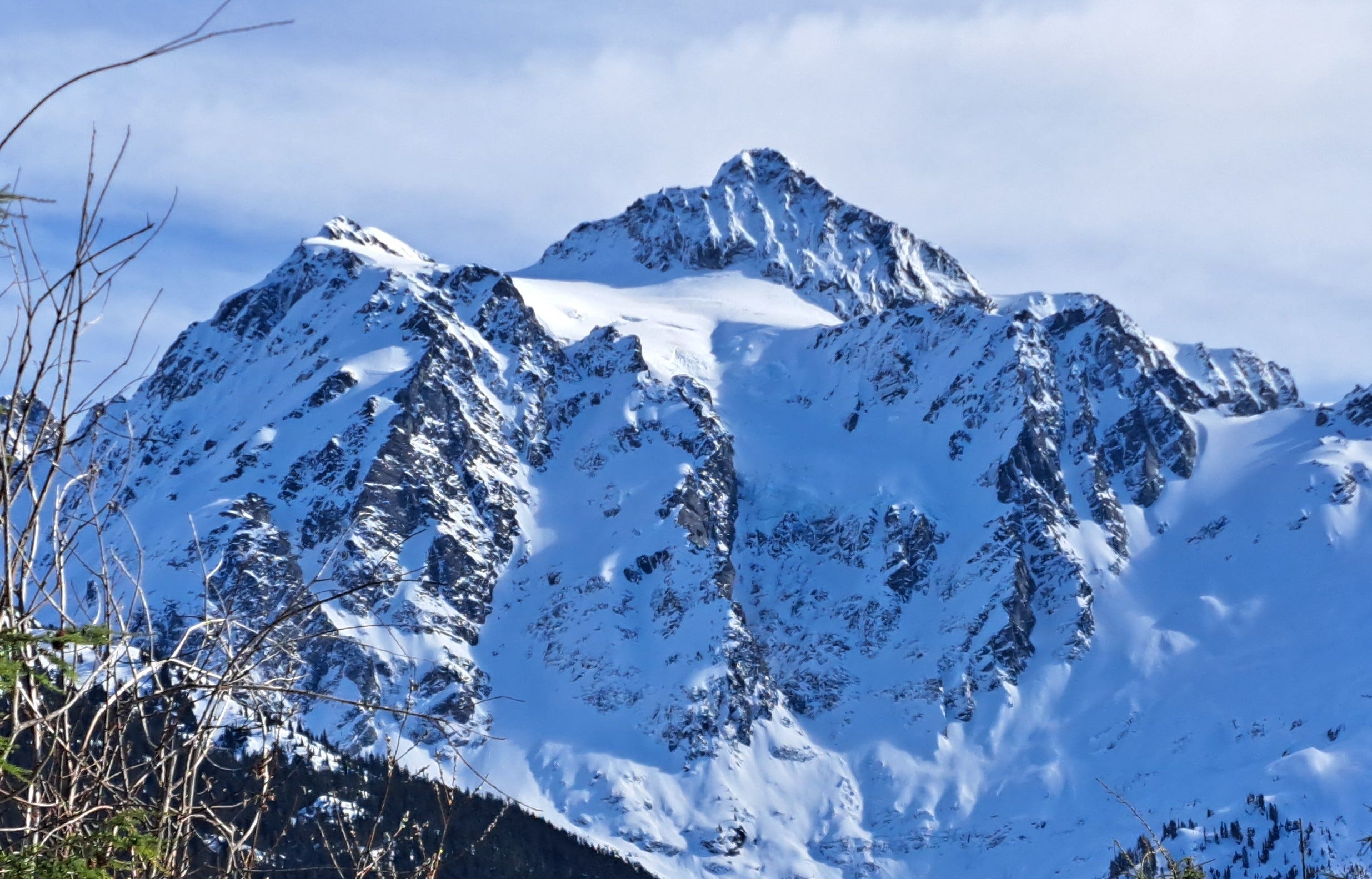
We hit the trail just after 5:00 a.m. Almost at a trot, we passed Lake Ann in an hour, a thrifty four-mile-per-hour pace. We found our way to the base of the chimneys, gaining about 400 feet to reach the official park boundary about a mile above sea level. We spotted a couple of parties ahead of us. One group we passed at the margin of the White Salmon Glacier where climbers, us included, normally strap on the crampons and rope up.
We kept our bullish pace going across the Upper Curtis Glacier and up and around a snowy ramp called Hells Highway. From there, the Sulphide Glacier led to the rocky, 600-foot-high summit pyramid that’s so conspicuous from afar. Beckey’s guidebook mentioned a “sporting” alternative up the southeast corner that was rated Class 3 or 4. We’d made such good time, we decided to give it a try. With a running belay weaving in and out of rock horns, we danced upwardly while gazing straight down the headwall of the sprawling Crystal Glacier.
Energized by the views, we were up the ridge in no time and on the summit by 10:00 a.m. Despite our fairly quick ascent, I’m sure we didn’t set any records. Nevertheless, our two sets of mountain boots were clearly on fire for this one. After a good break admiring the endless streams of craggy mountains in all directions, we headed down the pyramid, then the glaciers, Hap Fisher’s chimneys, and were back home in time for dinner.
Coming soon!
