

This is the third of a seven-part series about a December 1982 trek across the Baja—enjoy! Will post Part 4 tomorrow. Part 1 is here. —Ken
Waking up at our beach camp—let’s call it Camp Pelican—in San Felipe, we repacked and wandered about town in search of cheese, bread, pancake mix, cookies, fruit, pasta, rice, sauces for meals, instant oatmeal and the like. We packed seven days’ worth, expecting to complete the entire desert-mountain crossing in less than a week. There would be water in the mountains and wood for cooking, so we did not carry a camp stove nor the extra burden of liquid fuel.
We asked around about the old road to Rancho Santa Clara. A half-dozen denizens pointed us in a half-dozen directions. A local police officer looked at us strangely when we explained our intentions, then raised an arm and sighted down his finger.
“Allí," he said. “A la derecha.” He told us where to turn. “Muy lejos." Far away.
“Si señor. Somos alpinistas.”
We explained that we were experienced mountaineers and that we were well prepared—not to worry. By the lift in his eyebrows, I think we provided the day’s entertainment for the young officer.
Provisions secured, we returned to our base camp at the seaside park. An older Mexican fellow wandered in to greet us, eager to sell us some of his clams. We declined, but gave him a few pesos for a bumper sticker he was carrying. It read Happiness is a warm clam, his marketing slogan. I watched the last of the pelicans pluck late-night snacks from the Sea of Cortez, and crawled into the sack. I slept well that night, drifting off with thoughts of scrambling on granite.
In a small Mexican town like San Felipe in the early-1980s, one might expect to encounter a kennel’s worth of dogs milling about in the night, scavengers looking to raise some innocent hell with a pair of unfamiliar gringos like ourselves. Instead, we were met by feral cats. Too many to count. We hung our food bags from nearby posts, just in case.
As we snoozed blissfully, like poor-boy sandwiches snug in our cellophane wrappers, the cats invaded our food supplies. These kitties were sly, as we slept through the whole affair. We arose at dawn to tantalizing views of the mountains and the sea—and a scattered food crisis that displaced any notion of goo-gah serenity.
Clawed bags and wrappers were strewn everywhere. Nuts and chocolate were intermingled with rice and noodles. Much of the wonderful fresh bread we had acquired the day before had been ripped open and gnawed on. Worse still was the tragic loss of about four pounds of fresh cheese. Despite our misfortune, we had to admit that the mess was not nearly as disturbing as it was hilarious. We spent the morning picking up the evidence and reconstituting our shopping list.
We were still just a few days out of Bellingham, yet we had passed through another traveler’s time warp that made me feel like we’d been in Mexico for a week. What that also meant was we were anxious to get the hell out of town. It was time to make our way into the wild side of the Sonoran Desert and the San Pedro Mártir.
Repacked for adventure, I’d have been jumping up and down with glee, if not for one other minor distraction. The day before leaving Bellingham, I'd tripped down some stairs at the university and badly turned an ankle. In San Felipe, I was still limping along, my ankle throbbing and swollen.
The clepto-kitty incident presented a handy excuse for delay, and since we’d already burned up a good part of the day restocking, I suggested we spend one more night in town for some extra ankle recovery. We’d head out early the next morning. Once again, we suspended the food bags, this time hanging freely from taught lines instead of posts. We made it through the night unburgled by the roving herd of outlaw cats.
Early the next morning, after dipping our toes in the Sea of Cortez, we slid into our boots, loaded the overstuffed packs onto our backs, and marched westward. Or rather southward, as the officer had pointed, until we found the right turn that would aim us toward the mountains. With so much food and water to carry, along with street clothes, warm stuff, rain gear, ice axe, and my all-important mask and snorkel for a later swim at Cabo San Lucas, my pack, needless to say, was seriously overloaded. I carried my bedroll separately, slung over my neck and shoulder Kung-Fu-style. At least I’d be ready for any napping emergency that might arise. We walked and limped silently toward the ruffled horizon.
Two hours into the trek, a line of dust formed ahead of us, and a farm truck materialized in the haze. The old farmer braked to investigate the two-legged mules with backpacks slogging along the road.
“Buenas tardes, señor," I said. "Vamos a Rancho Santa Clara. Conoce usted?”
A little stunned, he said, “Rancho Santa Clara!?”
“Si.”
“Rancho Santa Clara!?” he repeated, louder this time. His face was as burnt brown as the desert was burnt gray. The lines of disbelief appeared well worn into his forehead and the sides of his eyes.
“Esta muy lejos!” he said.
“Si, pero somos alpinistas,” I said. “Vamos a la sierra.”
“Muy lejos.” Very far.
“Si.”
He proceeded to tell us we were on the wrong track if we truly were headed to Rancho Santa Clara. I didn’t understand the directions he offered, but I did gather that he was telling us to return to San Felipe to find the correct road. Good grief. We motioned to the back of his truck and he flicked his hand, as if to say, “Of course.”
Back in beautiful San Felipe, we asked around again for directions, beginning to feel a little silly, like two lost Gumbies in search of the claymaster.
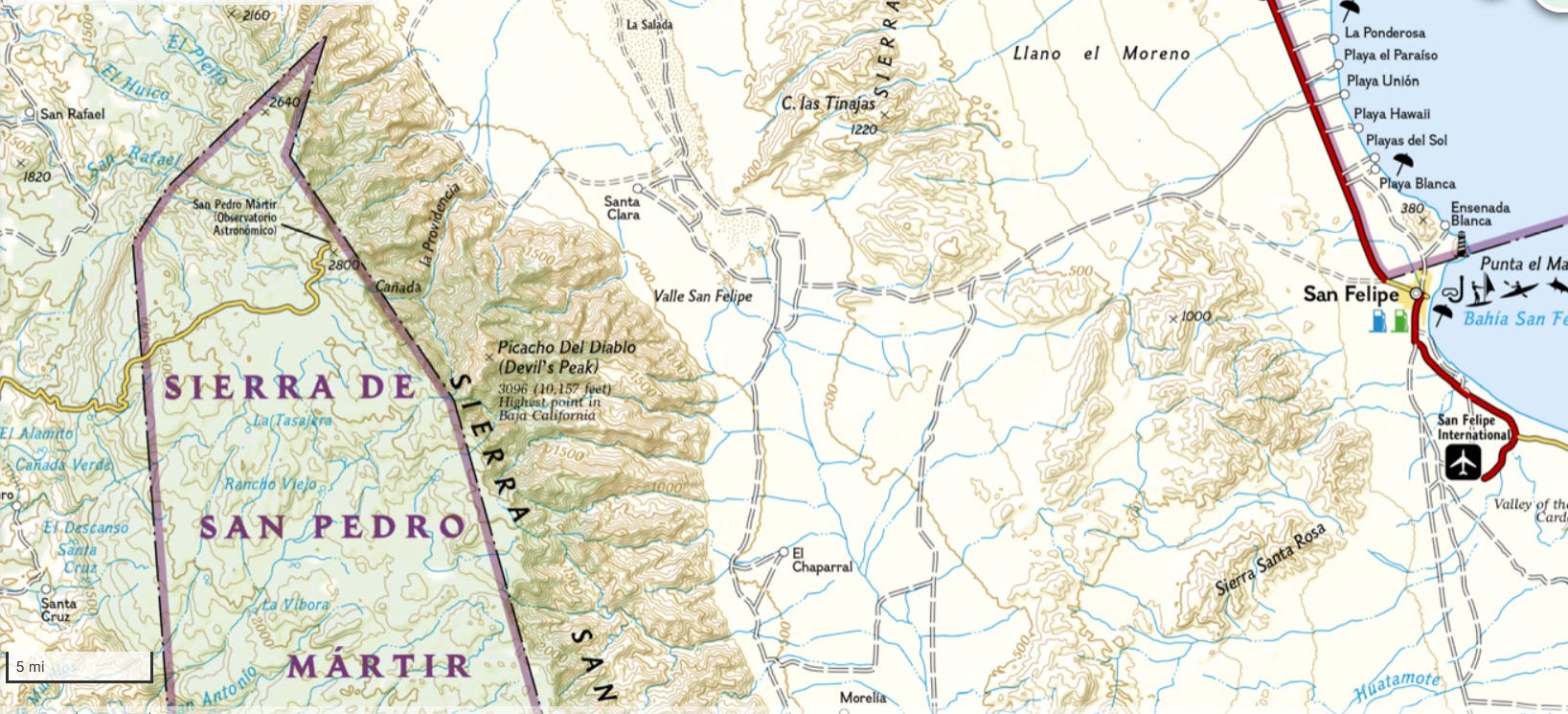
For trip planning, all we possessed was a general road map of the Baja and two topographical maps of the mountains that my good friend Janet had copied for us at the university’s map library in Bellingham. The details were coarse and did not extend to the desert, nor to San Felipe. I was confident, however, that we could navigate through the mountains, if we could just find the correct place to start.
Having blown a couple of extra days already, thanks to my sad ankle and some wily cats, we were eager as ever to get on with it. We waddled over to the bus terminal. I showed the ticket person our road map and asked about the possibility of getting dropped off near a pass to the north that was labeled on the road map. It appeared that we could shorten the desert walk to about half the distance, maybe 15 miles at most, if we started there and followed a compass bearing to Santa Clara. The ranch was marked by a tiny black dot on the map, though it was anyone’s guess if the dot was in the right place.
Dennis agreed to the new plan, though I detected a sardonic look in his eye. The bus ride meant letting go of the great feat of walking across the Baja from sea to sea. But it also meant reclaiming one of the two days we had already lost, as well as one less day of ankle torture. The mountains were the main prize, so we weren’t by any stretch giving that up.
“No problema.” We could get dropped anywhere we liked. Crazy gringos.
We had some time yet before the bus would leave, so we relaxed over a beer at a local cantina. I ordered a cold Tecate. I’d had them at home, but now for strict research purposes, wished to see how they tasted in Mexico. Spectacular.
We soon met the mid-day bus. The driver’s eyes bulged when he tossed our backpacks and four gallons of water into the baggage bay underneath. I planned to drink the first half gallon as quickly as possible to keep hydrated and lighten the load. To compensate for the guilt I felt for abandoning our original plan, I’d also lashed a six-pack of Dos Equis to the top of my pack. If we were going to the Canyon of the Devil, we might as well imbibe.
We stepped aboard, onward to the Sierra once again.
Next up: Part 4—Desert Stars