

This is the final part of a seven-part series about a December 1982 trek across the Baja—enjoy! Part 1 is here. —Ken
It was too cold to stop walking and too cold to camp at 8,000 feet. Our sleeping bags were slightly damp from the night before, the fresh snow having leaked into our bags while we slept. We kept walking the road into the night, gradually descending and presuming that we would eventually reach some kind of park shelter, or at least lower ground and less frigid temperatures. The road did not agree, however, and began to lead us up and over a pass. Hours passed and the walking seemed endless, my ankle back to swollen and throbbing.
Sometime in the wee hours we arrived at a collection of small buildings, the apparent park headquarters, though closed for the winter. We poked around, looking in windows with our headlamps, and found a one-room cabin with a bunk and wool blankets. We carefully removed the window with an ice axe, crawled in and shared the skinny bed for the duration of the night. Neither of us bothered removing our jackets, hats or gloves. Compared to the previous two nights, we’d scored a deluxe accommodation.
We awoke mid-morning to find a machete under the pillow, glad we hadn’t disturbed its rightful (or frightful) owner in the dark. We hung our sleeping bags on a clothesline. For breakfast, Dennis spotted a frozen can of soup on a shelf and thawed it over a small fire. We had a cupful of pancake mix and some honey left, but our stores were otherwise exhausted. We tidied up the cabin and blankets, replaced the window and were soon on our way.
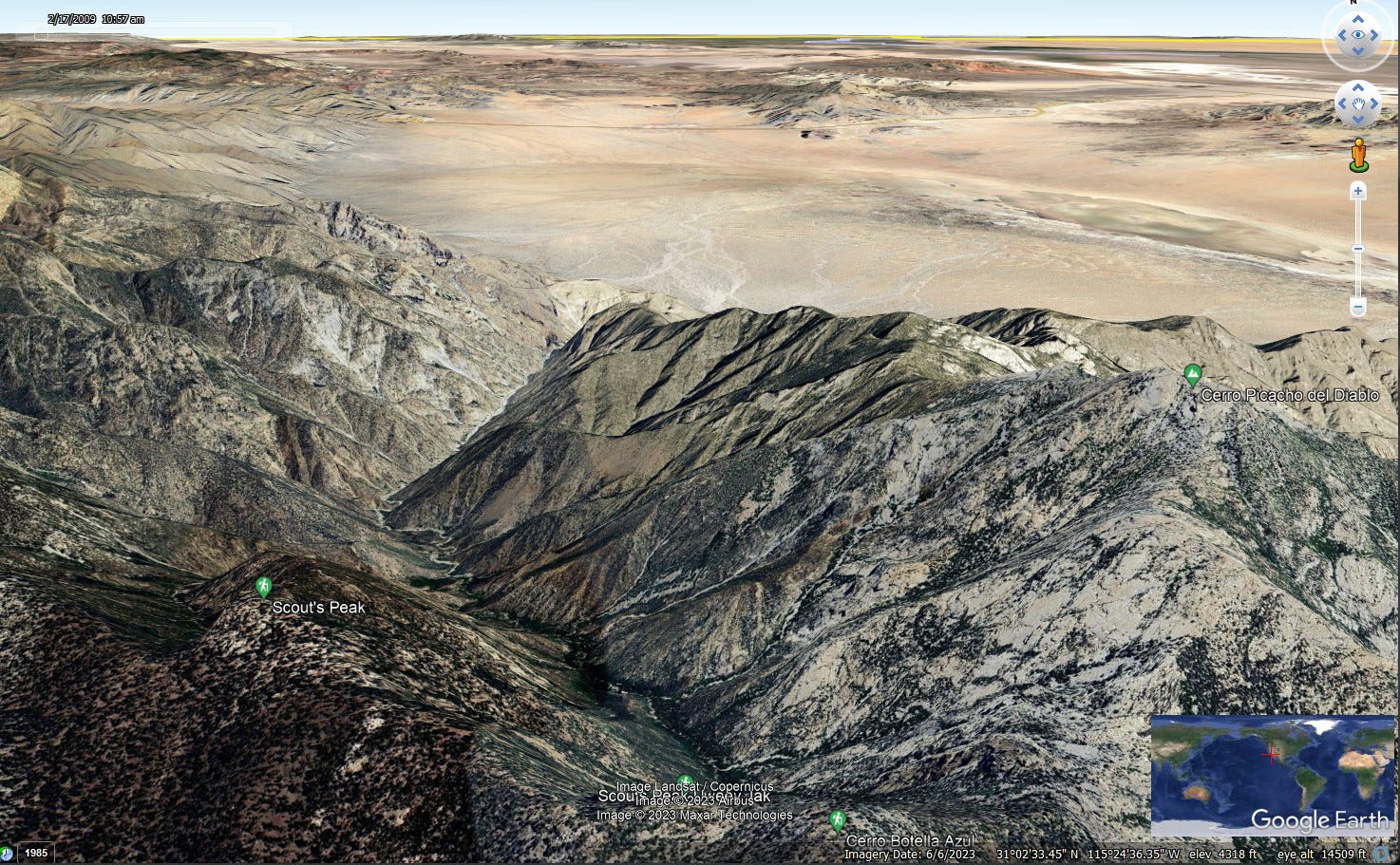
Happily, the road led downward this time, down and down and out of the snow. Then down some more and out of the forest. When we rounded a bend with a fabulous view of the western foothills and desert country below, the rest we knew would be a splendid, welcome stroll, notwithstanding the ankle thing. By now, the throbbing was paired with the sting of an ugly blister. The air warmed rapidly and we soon stripped down to T-shirts. Dennis trotted ahead, leaving me limping along and catching up later.
Something shiny along the road edge caught my eye, breaking my rhythm as I turned to look. It was a small metal spatula with a burnt plastic handle. I picked it up as an kooky souvenir to remember our trek.
At twilight, after twenty more miles, we reached Rancho Meling. We walked to the front gate, and I turned to Dennis. “Well, dude, I got us out of the mountains. You find us a bunk for the night.”
That was a bit of a stretch. Yes, I’d done most of the navigating since the summit of Blue Bottle, though Dennis could have managed it just as well. All I’d really done is point the compass and follow it.
Dennis walked up to the front porch of the old ranch house. It was brightly lit and we could see people milling around through the windows, as if some kind of party was underway. He knocked. A mustachioed fellow answered the door with a broad smile and immediately motioned us in. We dropped our packs on the porch and stepped inside. We’d lost track of the days, but looking around at all the happy faces and decor, I quickly understood the festivity. It was Christmas Eve.
A number of ranch hands and the owners’ extended family were celebrating with an enormous feast and an array of desserts and spirits spread across several rooms. We were nearly starving and here was more food than we could imagine piled to the rafters. The aromas were dizzying. We were introduced to Aida, the matriarch as well as her aunt, daughter and granddaughter—four generations of Norwegian resolve that had kept the ranch going since Aida took it over from her parents in 1955.
Rancho Meling was both a guest ranch and working cattle ranch spread across ten thousand acres of desert and the foothills of the Sierra de San Pedro Mártir. No one seemed particularly interested in our trek over the mountains, but we were warmly welcomed to join in the felicidad. Although most seemed to have eaten already, they were quick to point us to the mountains of food that remained, and we devoured more than our share.
Miraculously, we were offered a room for the night. There would be no hot water and no heat, since the ranch did not normally accept guests over the holidays and the utilities were turned off for the season. But who needed heat when there was enough hospitality flowing through the place to melt an igloo.
The next morning, we were invited to sit at a long community table and again gobbled up a huge breakfast with the clan. Afterward, Aida offered us a brief tour of the main house. She’d been very quiet toward us, both at breakfast and the evening before. On the way over to the house, she politely scolded us for being crazy enough to cross the Sierra in winter.
“I wasn’t too happy with you when you came to the door last night,” she said. “You know, people die up there.” She noted that search and rescue helicopters typically stage their operations at the ranch.
“They usually bring out bodies this time of year.”
She’d made her point and let it go.
We learned from Aida that movie stars, governors and presidents had stayed here. The ranch also contained a gold mine up in the Sierra. Following a shoot-out with some of Poncho Villa’s gang in 1911, the same year as the first known ascent of El Diablo, the former ranch house was burned to the ground.
“There’s a lot of history here,” she said, pointing to a bookshelf full of stories from Rancho Meling and the northern Baja.
I scanned the bookshelf and looked around the room, imagining Poncho Villa napping in a rocker with a rifle across his lap. Then as quickly as it began, the tour was over.
“You’ll be leaving this morning,” said Aida.
She walked us back outside. Of course, we would have enjoyed a longer stay, but this was Christmas and the family’s well-earned down-time at Rancho Meling. We offered to pay something for the room and meals provided, but she declined. I promised to return one day as a bonafide paying guest.
Repacked and re-watered, we hit the dusty road around noon, hoping we could eventually hitch a ride to Highway 1, 30 miles to the west. My swollen left foot and ankle had screamed when I put my boot back on and I hobbled for a few minutes adjusting to the pain, before reclaiming my clumsy, rhythmic gait. Dennis exhibited great patience sauntering ahead a mile or two, sitting to nap, and waiting while I caught up. Tortoise and hare all the way.
We walked until dusk without seeing a vehicle. I feared I would be dragging myself down all 30 miles to the highway. We probably covered half the distance that day. We carried no food for lunch, but were doing well enough, thanks to that hearty breakfast. Our water lasted, as the day was just comfortably warm. As long as I could keep walking, we’d be fine. We could be hungry for a day, subsisting on visions of slurping tacos and Margaritas on the beach.
After a long jaunt alone, I spotted the tiny figure of Dennis a half-mile ahead. He’d selected a spot for our final camp for the night. From his pack, he pulled out the last of our food: the pancake mix and honey. He stirred it with splash of water in a small pot and placed it over a wood fire. The trick was to cook it slowly so that the upper regions of the pancake were somewhat cooked before the bottom turned to charcoal. I retrieved my fabulous souvenir, the mini-spatula I’d picked up on our way out of the San Pedro Mártir. I brandished it like a weapon, ready to stab the half-burnt pancake in the mess pot. We took turns scraping the mess from the pan. And so we enjoyed a most memorable Christmas dinner, the expedition’s last supper, as the sun sunk below the horizon.
The adventure ended the next day, our ninth since departing San Felipe. After a few miles of early morning walking, a pick-up truck from Rancho Meleng approached. The gentleman behind the wheel was kind enough to offer us a lift the last few miles to the highway. He said we could flag down a bus from there and be on our way.
Then there it was, the Pacific Ocean. With a measly five more miles of walking, we could have splashed our weary feet in the surf. But we’d salvaged a fairly respectable adventure and felt no need to prove anything by mushing more sand between our toes. We’d do it right next time, I thought, sea to shining sea.
A minute later, a bus appeared over the horizon, rolled to a stop and gathered us up for the next coveted stop on our journey: a return to the Sea of Cortez and the beautiful sand beaches of Mulegé.
I originally wrote a story of this adventure about 40 years ago, which is the main reason I was able to recall so many details. My writing has hopefully improved a little since then. The mangled ankle eventually healed up, and I still love hiking up hills.
Reliving the experience has given me the bug to zip down there and do it all over again, from sea to shining sea, of course. Maybe go early fall this time, and with a lighter pack to better the odds of making it up El Picacho. By the way, I still have that mini-spatula, so I’ll definitely have to carry it along. But might just leave the mask and snorkel at home next time.