

This is the second of a seven-part series about a December 1982 trek across the Baja—enjoy! Will post Part 3 tomorrow. Part 1 is here. —Ken
The bus ride to San Felipe was somewhat less eventful. Rural Mexico sailed past the big side windows of the bus, and I frowned at my decision to not bring a camera. Instead, I carried a sketch book and pencils, intending to apply my nonexistent drawing skills to paper to record the best memories. It was wishful thinking and something I would totally fail at.
In any case, this was to be my longest, most remote vacation ever. Five weeks’ worth. I was feeling giddy to be swapping the cold December rains of Bellingham for the sunny beaches and arid mountains of Mexico. Dennis would also enjoy a nice break from his biz. Unlike me, though, he was a seasoned traveler, including prior forays into the deeper parts of real Mexico. He was quite at ease traipsing about foreign lands—notwithstanding the occasional rogue taxi ride. As a late-Sixties refugee from San Francisco’s Haight-Ashbury, he was a rebel-pessimist on many things civil and political. Personable and well educated, Dennis knew both how to travel and how to live.
For my part, I’d never gotten past the border towns, including a two-hour visit once to Puerto Peñasco in 1971, when my high-school buddy, Bob, and I toured America in his dad’s sparkling new Datsun 510. We also poked around Juarez, across from El Paso, where a guy on a bicycle rode alongside the car trying to sell us cigarettes, marijuana, and ultimately his sister, before giving us up for nerds. On the way back into the U.S., we were asked at Customs to step out of the car, while two border agents scoured it inside and out for contraband. To our great relief, they found nothing of interest.
Our bus rolled through the desert offering a glimpse of the abrupt escarpment of the San Pedro Mártir, a formidable looking barrier we’d need to cross. We presumed a higher bump on the distant skyline was the darkening silhouette of our stony objective, Picacho del Diablo.
We arrived in San Felipe early in the evening, gathered our packs from the belly of the bus, and explored some options for dinner. At a quiet city park on the beach we established our camp, vaguely wondering if we might be breaking any rules. The stars were glittering when we settled into our bags, the soft sound of the waves lulling us to sleep. No elephants tooted, and we weren’t evicted.
We awoke in the morning to prolific brown pelicans diving sideways into the sea and lifting off with wriggling fishes in their oversized beaks. The day was spent wandering the quaint coastal town, shopping for goods, and packing for the big foot-stomp across the Baja. There didn’t seem to be many people out and about, and I guessed the population of the surrounding area might be a few thousand.
The region between the Sea of Cortez and the crest of the San Pedro Mártir was originally inhabited by the Kiliwa Indians. The Kiliwa hunted and gathered from the mountains to the sea. They managed to thwart non-native invaders for more than two centuries following Hernan Cortez’s defeat of the Aztec empire in 1521. In the nineteenth and early twentieth centuries, sporadic settlement nevertheless moved in, and fish camps were established at San Felipe Bay. The community would ultimately grow and prosper as a busy port for fish, cargo and eventually tourists. Electricity arrived less than twenty years before Dennis and I did.
San Felipe was then, and still is, a key focus of some of the most famous off-road desert races in the world, the Baja 250, 500 and 1000. Hundreds of competitors in souped-up cars, buggies and motorcycles race in long, meandering loops or across great expanses of the Baja. Major events are typically held in the spring or fall. Anyway, we hoped that was the case, preferring not to end up in the midst of some mega-dust cloud during our placid December hike.
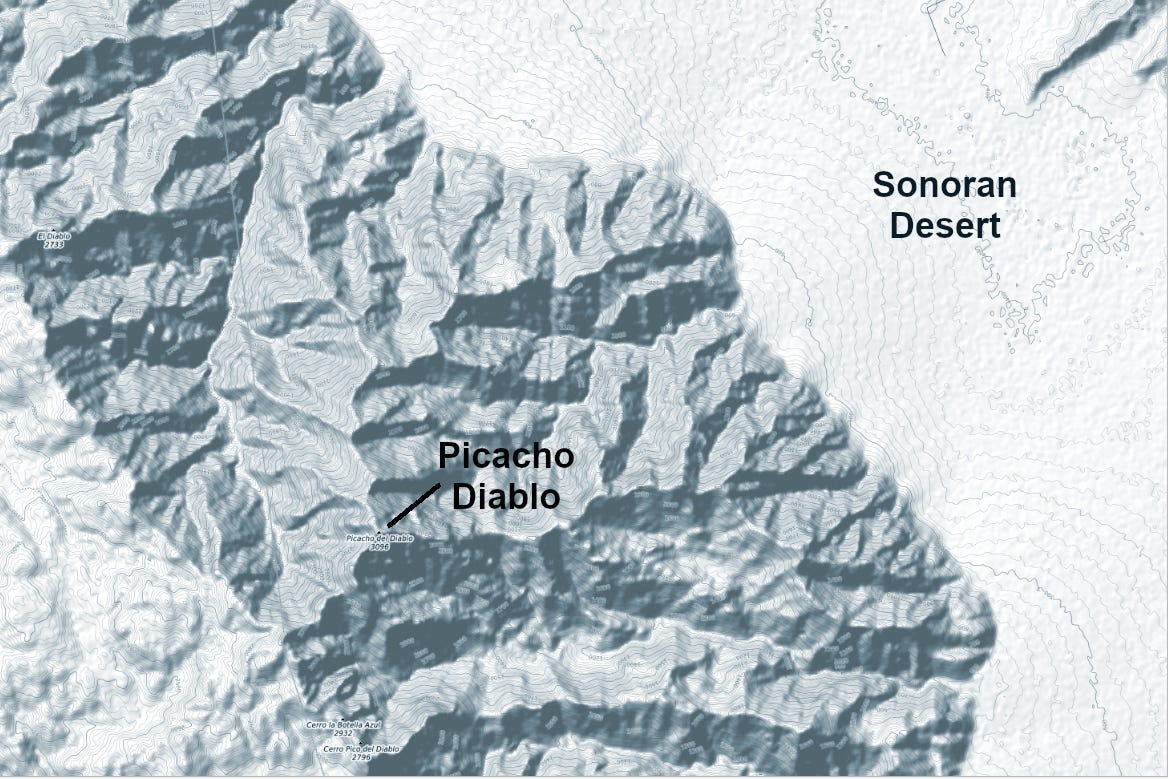
To reach the escarpment, we would have to cross 25 miles of the Sonoran Desert, partly along dirt roads, partly across a dry lake bed called Laguna Diablo (or Laguna Santa Clara). I wondered if anyone other than the Kiliwa had made such a trek before. Explorers, settlers, hunters, prospectors, marauders or others had surely made their way through the desert and/or the Sierra at one time or another. But had they done it in mountain boots? Dipped their toes in both seas? Had they climbed the highest peak along the way?
The Sonoran Desert is named for the Mexican state of Sonora, possibly a twist on the spanish word for woman, señora. It’s the hottest desert in North America. It envelops the northern portion of the Sea of Cortez and extends north into southwestern Arizona and southeastern California, and south perhaps 60 miles beyond San Felipe. Mean daily high temperatures exceed 100 degrees F. from June through September. December usually tops out in the 70s.
As for the mountains, the Sierra San Pedro Mártir is something of a little brother to California’s Sierra Nevada. The range spans about 60 miles north to south, ten miles east to west, and rises to almost two miles above sea level at the summit of Picacho Diablo. Our access to the peak: Cañon del Diablo. The deep gorge trends west at first, then thumbs its nose at all the other canyons by bending sharply to the south for about six miles, sometimes over 4,000 feet deep, before reaching the base of Picacho Diablo.
At the foot of this wall of mountains, we hoped to find Rancho Santa Clara where we might replenish our water and perhaps gain some useful tips for finding our way. I was unconcerned about the desert crossing, since it would be easy hiking and not so hot in December. Still, we agreed we should each carry two gallons of water to be reasonably safe. The desert romp would likely consume most of two days with only modest elevation gain. Once across, we’d need to find the correct canyon to begin our ascent. We understood there should be water flowing from the canyon.
Picacho del Diablo, the Devil’s Mountain, was first climbed in 1911 from the west, which has remained the favored approach. The first ascent from the east, the San Felipe side, was by Randall Henderson and Norman Clyde in April 1937. They made a direct and difficult ascent from the desert floor below the peak. Dennis I planned to follow the longer, more moderate route up Cañon del Diablo, an alternative I’d read about in an old guidebook to the area.
The towering granite peak is also known as Cerro de la Encantada, The Enchanted Peak, giving it a kind of schizophrenic nomenclature that makes you think again about going up it. It has also been called La Providencia, or sometimes just El Picacho or El Diablo. Devil’s Mountain also works.
By 1982, the mountain had been climbed many times, but if anyone had summited during a traverse of the Baja from sea to sea, we were not aware of it. Rarely, had it been climbed in December, due to the prospects for snow and ice high on the peak. It was comparable in height to the Koma Kulshan (Mount Baker) volcano near our home town of Bellingham. It too rises about two miles above sea level, but being 1,000 miles farther from the equator, it’s encased in glacial ice on all sides.
The Sierra de San Pedro Mártir was not only wilder than California’s Sierra Nevada, but in 1982, much less visited. A national park was established for a part of the range in 1947. Roads and facilities were constructed west of the crest, offering easier access to El Diablo. However, by going in that way we would completely miss the desert and the canyon we very much wanted to see. The romance of a Baja crossing from the east seemed far more tantalizing.
The San Pedro Mártir rises gradually from the west to a high, rolling, forested plateau, then falls precipitously to the desert on the east. Steep canyons lead down the face of the escarpment, one of which, Cañon del Diablo, would take us to our peak and to the crest of the range. Once over the top, facilities at the national park suggested supplies and at least some degree of creature comfort, as well as a road we could follow down and out of the mountains. The same road continued north a few miles to an astronomical observatory located high in the range on what is still acclaimed as one of the darkest and finest observatory sites in the world. It was out of our way to go there, though we contemplated doing so.
Given the distances and topography, a number of days would pass before we got our first good look at El Diablo.
Up next: Part 3—Camp Pelican